Most people who know me know that I am a cold weather person. I like snow, I like the cold. A few years ago in Minnesota it dropped down to -40F and I remember loving the thrill of walking to work in weather so cold it could kill me.
Most people who know me know that I am not a hot weather person. 75F is the hottest temperature I can generally tolerate. Anything about that and I cease to exist. I burn easily and overheat even easier.
Most people know that I moved to Namibia just over a year ago. Saying it's hot hear does not begin to cover it. Late spring and early summer bring the hottest weather to this country. It becomes so hot that sitting in front of a fan does nothing but blow hot air in your face (but you do it anyways because at least it feels like you're doing something). At night, you can't sleep because it's so hot. During the day, it's hard to eat, hard to move because it's just so hot. There is no boredom like heat boredom, where you can't do anything because everything requires moving and moving raises your body temperature. The only relief is to soak in cool water long enough drop your body temperature.
Though I am not in love with this part of veld life, I still am grateful for the experience. I now know that I'm missing nothing by aspiring to move to the Arctic Circle. On the plus side, I finally managed to get wifi in the village. I supposed I'll have to start walking a bit more to use the internet, even though it's hot.
Showing posts with label namibia. Show all posts
Showing posts with label namibia. Show all posts
Wednesday, December 21, 2016


Wednesday, September 28, 2016
Radio Nowhere
It is a well known fact around these parts that my village
doesn't have radio. I’ve heard the neighbors occasionally get a Nama station
to come through, when the weather, wind, and dust are at the appropriate levels
of not debilitating, but I felt it would be a pointless purchase. I have a deep love for radio – something to do with too
much NPR growing up, no doubt – so when a friend recently offered me one that
they didn’t need, I couldn’t say no even though I knew it was mostly useless at
site. It’s new and nice but has that old school feel of a portable radio that
is only a radio. Five bands, all of which play nothing but static.
The other day I was spinning round the dead dial, hoping to
hear a little rhythm and I stumble upon the strangest sound. It was not a thousand
guitars or pounding drums, but a voice speaking in a tongue I hadn’t head in a
very, very long time. There is a Japanese radio station here in Namibia. Etse! I tuned in again a few days later to listen to a hearty, American voice tell me
Hillary Clinton has pneumonia. Apparently only one station can come in at a
time, only one language can be heard on a given day. You have to fight with the
static to hear. Something about nuclear tests, South Sudan, civil war, a cyber
attacker, and a bunch of other news bites are lost because those were the only
words that won out against the drone of fragmented waves.
There might not be any saxophone solos coming my way, but
sitting out here in the wild blue I do feel like I have a purpose here. Some
days it’s harder than most. I spin that dial round and round and think is there
anybody alive out there? But then, in the smallest ways, at the oddest times, I
finally find that MAKE THE CONNECTION.
I love radio. I love my radio nowhere as I sit, looking for
a world with some soul. IT’S A WORLD RECIEVER! it tells me right on top. Good.
UPDATE: We have radio now!!! I wrote this about two weeks ago and suddenly, out of nowhere, BAM! Radio! But it shuts off a lot... I did manage to hear a few waves about the debate!
Friday, September 23, 2016
Some Laundry
Imagine: It is nearly 11PM, the clouds are starting to break
up and the moon and stars are shining so bright you don’t need a flashlight.
The door to Ms. Sheldon’s flat opens, first the wooden one, then the metal
bars, quiet like. Somewhere across the bush, a child giggles. Goats stamp. A
dog barks. The hostel is dark. Ms. Sheldon darts for the clothes line where a
single blue and green comforter hangs, blowing gently in the breeze of a spring
night. Ms. Sheldon checks for wet spots. A bit damp, but fine if another
blanket goes underneath. She quickly pulls the pins from the line and hauls the
blanket off, careful not to let it touch the dusty ground least the process of
the past evening be repeated. With one last glance across the open bush, she
dashes back towards her door and slips in. The night settles in around her.
Lately, Lalli the Cat has taken to peeing on everything
(because I changed his cat litter). The above scene took place the evening
after I caught him in the act and managed to spare the rest of my just washed
bed set (after having washed it two days before when he did manage to soak the
thing). I was having trouble sleeping so I decided to be productive and check
the line again. Amazingly, once I had my comforter again I went right to sleep.
Friday, August 26, 2016
The View From the Road
Despite being banned from driving and other restrictive travel regulations, Peace Corps volunteers spend a lot of time on the road. Back in the States, my brothers and I used to complain all the time about being forced to sit in the back seat together for any drive at all. Now I'm used to being crammed into over stuffed cars, bakkies, and kombis, expecting multiple hour trips that usually end with something breaking. I spend so much time on the road, that I figure it's about time I learn how write about it.
 The most common trek I make is the one to town. I think most people by now know that I live in a farm village in the middle of nowhere. I am so in the middle of nowhere that when my dear friend Emma, who lives in a northern village without running water or electricity, came to visit, she felt the need to comment that I live in the middle of nowhere. I'm 100km from the nearest town and there is nothing but a lodge and a few houses to cover that distance.


I make this journey about once every two to three weeks to get groceries. I've made it in the back of a posh BMW and the back of a covered bakkie sitting on a foam China shop mattress. The latter is infinitely more common. Sometimes I have a scheduled ride from a teacher or one of the owners of the tuck shops (small shops that sell basic necessities, often for inflated prices). Other times I go to the community designated hike spot and I wait for someone to drive by. I try to avoid the second option because it often requires getting there by six in the morning and waiting for a few hours in the sun. There's not a lot of trees or tall bushes to hide under.

Sometimes I get to sit in the front of whatever vehicle I'm in. This is sometimes really great because I tend to know the driver and we might chat a bit. It also means getting to sit in a relatively comfortable position for the next hour or so as we cruise over the dirt road. More commonly, however, I'm in the back of a pickup, leaning against the canopy with some headphones in. I particularly love the rare times I'm alone in the back because then I can sing to my heart's content. Playlists range from a mix of punk to folk to pop rock.

Getting the ride out, however is less important than getting the ride back in. I have spent days at the designated hike point in my shopping town, flagging down cars and asking around for rides. If no one is going to to the village, no one is going to the village. There's only been one time when I missed school because of a lack of transportation. I ended up catching a ride back on a Monday afternoon and after that vowed to never again leave the village without a plan to get back in. I have failed to uphold that vow because I'm currently enjoying a long weekend in town with no ride back on Sunday.

Half of my trip is on a dirt road. Everyone complains about it and one time I even had someone go the extra 30km south to take the slightly better one. It's one or the other though, and most people prefer the short term save on gas to the long term save on suspension. Somewhere in the middle of this dirt track in the middle of nowhere is a dead zone. No cellphone service. Just dying grassland. When I first moved out here, I was terrified of this zone. If we got stuck out in the dead zone, we had as much as 20km in any direction to walk until we got out of it. The chances that someone else would come by were pretty slim. Now I don't care as much. When you have so little control over transportation, it helps to not care. If the car breaks down, it breaks down and me stressing that the driver is only doing 80km/h instead of 120 isn't going to get me anywhere. You learn to make your appointments flexible.

The other 50km is on a tar road, the B1, one of the most dangerous highways in the world. When I first moved here, I was terrified that something would happen on that stretch of road. Now I know there's no use worrying because there's nothing I can do about it except tell my students why it's important to follow the rules of the road and hope for the future generations. My favorite part of driving the B1, other than how smooth it is to drive on a tar road, is crossing the Tropic of Capricorn. Hi everyone, coming to you live from the tropics.

Back home, I was one of those people who never really drove a lot. I was either studying, living in a city, or living abroad. This past summer saw a huge hike in my driving time, largely because I loved my mom's new car and wanted to drive it everywhere. I started learning stick from a cousin and had a brief affair with the Subaru BRZ that made me realize one day I might be one of those people with a sports car. It's hard, sometimes, being on the wide open roads of Namibia and knowing that you aren't allowed to travel them yourself, but it's still an experience that I want to share.
Tuesday, August 2, 2016
August Wind
Happy August all!
Wow it's been a long time since I updated this. I have reasons, most of which are just excuses for not writing enough, but I'm turning over a new leaf!
It's August here in central Namibia and I have learned very quickly that that means the end of winter and the start of the August wind. Last week I was freezing cold. I woke up every day and put on five layers of clothes and wore them all day. I was so cold I got a heater. Over the weekend it got a bit warmer and then, yesterday, the wind started blowing. The wind brought with it a 20°C temperature change. This morning was easily around freezing, but as the sun rose and the wind picked up, the temperature rose to 23°C. That's around 75°F, for those of you who aren't my dad.
The August wind has brought more than just (dry) heat. It's kicking up clouds of dust and sand. Mrs. M promises a complete lack of visibility in the coming month. I'm both really excited to be living in a perpetual sand storm and silently morning the sad future this presents for my laundry. Oh dear! There is also this word thing the dust is doing to the afternoon sky. Though visibility is still good, the sky has turned a grey blue that makes it look like it's going to storm, except it won't because there's absolutely no moisture in the air.
When the sun goes down, the temperature begins to drop against at an alarming rate. Today, however, I hot the sweet spot. The sun was gone but still had just enough presence to turn the sky a purplish pink and as I walked home from my friends' house the wind turned cool. It was not some sort of pleasant little breeze but the same powerful gusts that blow off the prairie back home, making trees of the Forest creak and moan like they're taking to each other. There is no prairie here and there are nowhere near enough trees to constitute a forest, but as I walked home, I felt the same power and awe I feel in a good Kansas gale.
Wow it's been a long time since I updated this. I have reasons, most of which are just excuses for not writing enough, but I'm turning over a new leaf!
It's August here in central Namibia and I have learned very quickly that that means the end of winter and the start of the August wind. Last week I was freezing cold. I woke up every day and put on five layers of clothes and wore them all day. I was so cold I got a heater. Over the weekend it got a bit warmer and then, yesterday, the wind started blowing. The wind brought with it a 20°C temperature change. This morning was easily around freezing, but as the sun rose and the wind picked up, the temperature rose to 23°C. That's around 75°F, for those of you who aren't my dad.
The August wind has brought more than just (dry) heat. It's kicking up clouds of dust and sand. Mrs. M promises a complete lack of visibility in the coming month. I'm both really excited to be living in a perpetual sand storm and silently morning the sad future this presents for my laundry. Oh dear! There is also this word thing the dust is doing to the afternoon sky. Though visibility is still good, the sky has turned a grey blue that makes it look like it's going to storm, except it won't because there's absolutely no moisture in the air.
When the sun goes down, the temperature begins to drop against at an alarming rate. Today, however, I hot the sweet spot. The sun was gone but still had just enough presence to turn the sky a purplish pink and as I walked home from my friends' house the wind turned cool. It was not some sort of pleasant little breeze but the same powerful gusts that blow off the prairie back home, making trees of the Forest creak and moan like they're taking to each other. There is no prairie here and there are nowhere near enough trees to constitute a forest, but as I walked home, I felt the same power and awe I feel in a good Kansas gale.
Saturday, April 23, 2016
Exam Time and a Book Recommendation
I feel
like I start every blog post apologizing for not being able to update
regularly. The reason behind it this time is that I don’t have internet at site
and finding it in town tends to be totally hit or miss (until this weekend). So, I'm sorry. From now on I plan to start writing out blogs ahead of time then post them
when I get net. I wonder if I could even start a queue…
For now, I will just talk about how
things have been changing since exams started. My usual day is a teachers’
meeting at 6:45 (including morning prayers and songs) with classes starting at
7:00 and ending at 1:00. I teach between five and seven classes a day for three
different grade levels (see the last post). Now that its exams everything is
the same but instead of teaching classes, one class is sitting in my room for
to study from 7:00 to 11:30 when exams start. Each class has one exam a day
that they study for during the beginning of the day. As you can imagine,
studying for that long is a bit much for teenagers. So I’ve made a deal with
the kids who sit in my class. If they behave, we study for, say, 20 minutes,
then take a short break where they can get up and stretch or draw or read a
book. Then we study for 30 minutes and take a longer break. And so on. I also
play Two Steps from Hell music, which they LOVE. It’s been great because not
only are they getting studying done, but it’s also given us time to bond more.
A few weeks ago Jaye Shaer sent us
some books, which I will properly display once the term is done and I move them
into the library, but for now they sit on my desk so the kids can read them
during break. A girl named Esmie and I read one of the books together, Akata
Witch buy Nnedi Okorafor, and I really recommend it for middle schoolers
everywhere. It’s about a young Nigerian American girl named Sunny whose family
moved back to Nigeria. She’s albino so she really sticks out and has to deal with
the social stigma of looking different. One day after school, she has a chance
encounter with a classmate who introduces her to another girl in their
neighborhood. Sunny finds out that like her new friends, she is a Leopard
Person, a witch, and with her friends she begins to explore the world of
Nigerian and West African magic. But not everything is as calm as it seems.
There’s a ritual serial killer on the loose and Sunny and her friends are
tasked to stop him. The book was really fun and Esmie and I both loved it.
Wednesday, February 17, 2016
Long time, no write!
I have tried writing blog posts for months now, but it just
never seems to work out. Most of you who read this have probably heard that the
whole Karasburg thing didn’t work out. I’ve moved to village closer to
Windhoek, but on a dirt road the middle of no where. I actually really love it
here. I walked to work this morning listening to goats bleating and rosters
cock-a-doodle-do-ing. It’s super green and there are tall trees along the
riverbed (pictures soon, I promise!). I’ve made so absolutely fantastic friends
in the community who really take care of me. I now have a friend I buy fresh
bread from, a friend I buy meat from, and another I buy seeds from to grow the
vegetables I keep meaning to plant.
My daily life changes quite a bit as I’m adjusting to my new
responsibilities. I’m now officially a teacher. I teach English and girls’ PE for
grades 8-10 (junior secondary school). My kids are smart, funny, and creative
as hell. They are also little demons when they are all in a class together and
drive me crazy. One on one, or even in small groups, they are really fun to be
around, but when the class has 44 students and at least 5 of them are competing
for class clown with another 25-30 who just want to chat, it makes it
absolutely impossible to get control. I’m struggling a lot with this. But I’m
going to keep going. I’m alternating between being the horrible woman who gives
detention and the awesome teacher who gives out rewards for good behavior.
Lately I feel like the former is the most common side of me. My grade 8Bs were
actually really good today though. I promised them rewards tomorrow. Same with
one of the grade 9 classes. I teach five class groups in total.
Last night we had the school athletics tournament and it was
really nice. Participation in athletics is mandatory for all able-bodied
students (and some who lie and say they are, which caused a lot of drama last week!) and after a few weeks we have a
school wide athletics tournament and the top three in each event become the
official school team. I got to judge high jump, which, as most people don’t
know, is by far my favorite athletics event. Some of the kids stayed around to
help with raising the bar up and down and keeping everyone lined up. It was a
great chance to get to meet some of the students who don’t usually come and
talk with me, so despite having to sit in the sun for a few hours, I actually had
a lot of fun!
Despite that, my favorite part of the athletics tournament
was the community support. Thinking about it now almost brings tears to my
eyes. Even though our tournament was rescheduled for a week day, tons of
parents and community members came to support the kids. I talked with the
parents of a few kids and the level of pride and investment in their kids was
amazing. Back down in Karasburg, this just wasn’t a thing. Almost no one came
to support the students at the girls’ soccer tournament and the few that did
weren’t really there for the students. I talked to some of the teachers here
afterwards and they said that this level of participation is typical and it
warmed my heart to see that some of the kids really have a good support network
at home. It’s probably because this is more of a farming community while the
other school was in the Location. It makes me hope another volunteer will get
to go back there and work with community development because those kids really
deserve it (I obviously miss my K-burg kids a lot).
I’ve only been here a few weeks and it has been a crazy, roller coaster
of a time, but as my principal asks each day, I’m still swimming. I’ve made
more mistakes than I can count but I’m going to keep trying. I want to be a
good teacher because I know no matter how naughty these kids are, they don’t
deserve the disorganized wreck I’ve been the past few weeks. Right now I am open to any suggestions on classroom management and planning interesting and engaging lessons!!
Sunday, October 18, 2015
Officially a Volunteer and Moving to Site
For as long as long as I can remember, I’ve wanted to be a
Peace Corps Volunteer. I’ve wanted to be a volunteer for so long, that I
stopped asking myself if I really wanted to do it anymore or if I really
thought I could do it. It wasn’t until I had already accepted and started
preparing for leaving that I began the process of questioning my decision.
Going through training, I found myself asking myself more and more, “Do I
really want to be here? Am I wasting time and resources being here?” I wasn’t
having a tough time or anything, I just felt like I needed to really think it
over. On the 15th we officially swore in as volunteers, and that
childhood dream became a reality. And as that happened, I found those questions
that had harassed me all PST were gone and I was so ridiculously happy. I
walked through town that day in my Damara dress and thought I can do this. And
now I’m sitting in my flat in Karasburg, typing this up, and thinking there is
no place else I could possibly be right now.
On the 16th, two other volunteers and I made the
long trek to the deep south of Namibia, I however, went the deepest. Pull out
your maps of Namibia folks, ‘cause here comes a geography lesson! In Namibia,
most people only consider two regions north: Ovamboland and Kavango (Zambezi
and Kunene seem to be in another category that I haven’t quite come to
understand). Everything else is south. Windhoek is south. Okahandja is south.
So saying I’m in the south doesn’t mean anything, hence the “deep”. Karasburg,
where I now call home, is so far south, the nearest big city is actually in
South Africa. I am living in a teacher’s flat at school here and so far really
enjoying it. I went out yesterday to buy some dishes and what not. I don’t
actually have a kitchen yet, so I can’t buy much food (no stove and no fridge).
I get meals from the dining hall brought to my flat a few times a day by
learners, which took some getting used to. Still can’t say I’m too used it, but
it’s a good chance to get to meet some of them.
I made fast friends with the Afrikaans teacher, who is about
my age, and came to introduce herself to me the first night. I’ll probably end
up asking her to tutor me in Afrikaans since that’s what everyone speaks here.
And while I can understand a lot of what’s spoken at me, I can’t respond and I
understand nothing of what the kids are saying most of the time. At least
picking up Afrikaans should be easier than Khoekhoegowab, although I still hope
I can learn that as well.
Karasburg itself is a small town in the middle of nowhere.
It’s on a flat plain with mountains just barely visible on the horizon. There’s
scrub brush all around, but nothing very tall to obscure the view of the
plains. It makes me think of old west movies. In town there’s an Agra (farm
store), Shoprite (grocery), Spar (grocery), and PEP (clothing and house stuff).
When I walked into PEP yesterday, “Love, Love, Love” by Of Monsters and Men was
playing and it was the most surreal experience ever. Sometime later this week I
hope to go to Agra and look into starting a garden in front of my flat. It
would be something to do in my free time and help me save money on vegetables
and herbs. However, the rainy season is rapidly approaching, so I’ll have to be
really careful about when I start. I also have no idea how anyone gardens in
the soil here. It’s pretty much sand all around, but they manage, so I’ll ask
around and pretty soon so will I.
It’s tough to describe the land around here without sounding
like I dislike it, which is horrible because I really love it. It has its own
sort of sparse beauty that I came to love instantly, but when trying to
describe landscapes that don’t resemble home, I find myself without the proper
words. I hope I can get better at that over time, because it really is pretty
here. In town and in the location, people have gardens and paint their houses
bright colors. When I walk around later, I’ll try to get more pictures.
I’ve been spending some time meeting the students who live in
the hostel as well. They are all really friendly and I find them hilarious most
of the time. A few of them are really shy, so it can be hard to talk to them.
Most of the older ones speak English very well, so communication is not a
problem at all, but when they aren’t talking directly to me, they all speak
Afrikaans. I did manage to find a handful of them who speak Khoekhoe, so I
should probably see if they would be interested in letting me practice and
learn from them.
That’s it for now! I’ll try to update with more about
Namibia next time! There are so many small things that are different in how
people speak here that I want to make a whole post on it, so look forward to
that! I also want to talk about how the school system is set up, so maybe I can
combine the two. Feel free to ask questions in the comments, because I would
love to answer them!
Friday, October 2, 2015
I am grateful for...
I
thought of trying to structure this post around the grateful game. For those
who have never played, the game goes like this: people take turns saying things
they are grateful for. When we play here, the woman that usually starts the
game has a few extra rules she enforces strictly: no back-handed gratefuls, or
don’t say something that is more negative than positive, and it has to be
something you are really, truly grateful for, so don’t say something along the
lines of being grateful for oxygen or something. So, in the spirit of the game
and the extra rules, please read further.

Today
I’m moving from Outjo back to Okahandja where we have training and I’m pretty
sad about it. Not tears-streaming-down-my-face sad, but just sorry to leave. I’ve
really come to love it here in Outjo. Even things that were difficult at first
(mostly, figuring out how to navigate my host family) have become just normal
parts of my life here. After two months in Namibia, I had finally gone from the
numbness created by being unable to process all the changes happening around
me, to a relatively functioning human being once more. While here in Outjo, I
woke up at 4:30 AM every day with no complaints and a smile on my face for my
40 minute walk to work. And I loved it. I taught a class of 40 with no lesson
plan on my first week, and I loved it. I learned how to make lesson plans and execute
them effectively. I learned when the planned lesson is not working and how to change
pace on the spot. I (hitch)hiked for the first time.

I was a minor celebrity around campus, with kids from grades
I had never taught greeting me every day. I made the best Irish stew I’ve ever
cooked for my host family (and they ate it). I went to Etosha, the largest game
preserve in the world. I got really good at braiding my hair in the morning. I
figured out how to unlock the two doors and gate to get out of the house every
morning. I had real coffee. I practiced Damara with people I didn’t know. My
kids would greet me in town. I met half the town. I managed to live on hardly
any money. I made friends. I found out one of the guys on my program is related
to me (or that we have a recent common ancestor). I stargazed using the map my
friend gave me. I saw a ton of bats flying around and listen to them
echolocating every night. I finally found a place in my host family. I painted
my host mom a picture and she loved it.

The list goes on.

For the past four or so years I was in school, I have been
constantly stressed about a number of things. It eventually became so constant
that I didn’t even realize I was stressed anymore until now. While there is
obviously still a lot of pressure being here, I just don’t feel it the same way
I did back in Minnesota. I don’t want to get too deep here, but I really want
to emphasize how good a decision joining Peace Corps was for me. Even though I’m
the one who is supposed to be the teacher, I’ve been learning so much from
everyone around me, Americans and Namibians, young and old. I am so
overwhelmingly grateful for the experiences I’ve had so far and I can’t wait to
see where this journey will take me.

I’ll briefly wrap up with an explanation of the photos
scattered in this post, since there are a lot of them. I took all of these my
last day. Most are of my students in the 5th and 7th
grades. 7th grade was by far my favorite class. Those kids are so
awesome and I hope for the best for all of them. One is of the woman who sells
us fat cakes every day. One of the good things about Okahandja is my access to
fat cakes with disappear, so I hopefully I can go back to losing weight! Some
are of the San kids from the cultural club. One of them was one of the orneriest
kids we had to deal with, but we all loved him anyways because while he was a
little brat, he was really smart and would usually try pretty hard. He’s also a
fantastic dancer! We were thrilled he found an outlet for all of his energy!
There’s one of me and one of the other Minas at school. Mina is a very common
name in these parts. There’s one of me and our co-teacher Mrs. Kabajani as
well.

I guess I’ll sign off for now! In Okahandja I will not have
reliable access to internet again, so I may not be posting pictures for a few
weeks. On Monday I will try to briefly post about where I’ll be moving to (we
find out site placement at last!) and on the 15th is our swearing in
ceremony. The 16th is when we will move to our permanent sites.
Hopefully by then I’ll have figured out a way to obtain semi-regular access to
working internet so I can post some pictures!


Saturday, September 26, 2015
CBT in Outjo
Today marks the beginning of my last weekend in Outjo, so I
figured I should give some details about my life here! Last time I updated I
talked mostly about irregularities in my schedule, so today I will talk about
the excitement of my daily life. Usually, I worry that these sorts of posts are
a little dull, but I love my day to day life so much, I really want to talk
about it.


As I mentioned last time, I get up around 4:30 every morning
so I can be ready to leave at 6:00 and be at school by 6:40. When I leave the
house each morning, it’s still dark and the stars are still shining overhead. I
usually don’t see anyone until I get out of my neighborhood and into town. As
long as there’s not a ton of people, I try to greet everyone I pass, which is a
bit thing here. None of us have quite figured out the procedure for when to
greet and when not to, so we usually try to greet as often as possible. People
seem to really like that. With adults, I always great them in Khoekhoegowab,
students I always greet in English since I’m supposed to be an English teacher.
When you greet someone in Khoekhoe, it usually goes like this (for mornings):
Me: Moro moro!
Them: Moro moro!! Matisa?
Me: !Gâi ge a! Aitsama mî re?
Them: !Gâi ge a!
Me: !Gâi ge a! Aitsama mî re?
Them: !Gâi ge a!
And at some point they have started smiling a lot because a
white person is bothering to learn their language. Knowing local language earns
you huge brownie points, which is probably part of the reason that Peace Corps
is so popular here compared to other volunteer organizations. Lately a lot of
people have been asking me “Mapa du ra ī?” or “Mapa du ra hâ?” The first means
“Where are you going?” the second means “Where are you staying?” I usually get
the first one, for which I know to respond either “Maarseen skoli //kha,” or
“dorb //kha”. Occasionally I get the second, which once I accidentally responded
“Maarseen skoli //kha,” which means “to Maarseen School,” instead of “dorp !nâ”
which is “in town.” Sadly, I haven’t been getting a lot of language practice
besides that. Everyone here speaks English very well, except the occasional
white person, who then usually speaks German (of which I have enough of a basic
understanding to speak to them in German). Naturally, I speak Japanese with the
Japanese volunteers.
At school, I usually teach one or two classes a day. If I
co-teach, I might get four or five. Before we had worked out a solid plan for
teaching, I could end up teaching surprise classes, but this week we made clear
outlines so all the 5th and 6th grade English classes
would be taught by volunteers. For our last week I will only be teaching 5th
grade English, which is awesome because we are reading Charlie and the
Chocolate Factory and they kids LOVE it. We usually read a chapter or two a day
and then use words from the text to build their vocabulary. We are trying to
implement a Word Wall in the room, where vocab words are posted alphabetically
for students to see throughout the day. This is a great learning and teaching
tool because it not only lets students constantly have access to words, but it
also allows for a lot of activities for us to do. For example, last week Andrew
and I led a game called Guess My Word Wall Word. First, Andrew and I each
picked a word for students to guess. Then they would ask us questions like “is
it a verb/noun/adj?” “How big is it?” “What color is it?” and so on and so on. Sometimes the kids get a little out of hand. There is one of
the 5th grade classes that every teacher agrees is the worst class.
There are almost 40 learners, most of whom have strong personalities. They are
all really smart, though, which makes it even more frustrating. On Fridays,
however, everyone is a little rowdy. I taught last period on Friday this week
and it was horrible. I’ve never had so much trouble keeping control of a class,
and it wasn’t even the naughty one!
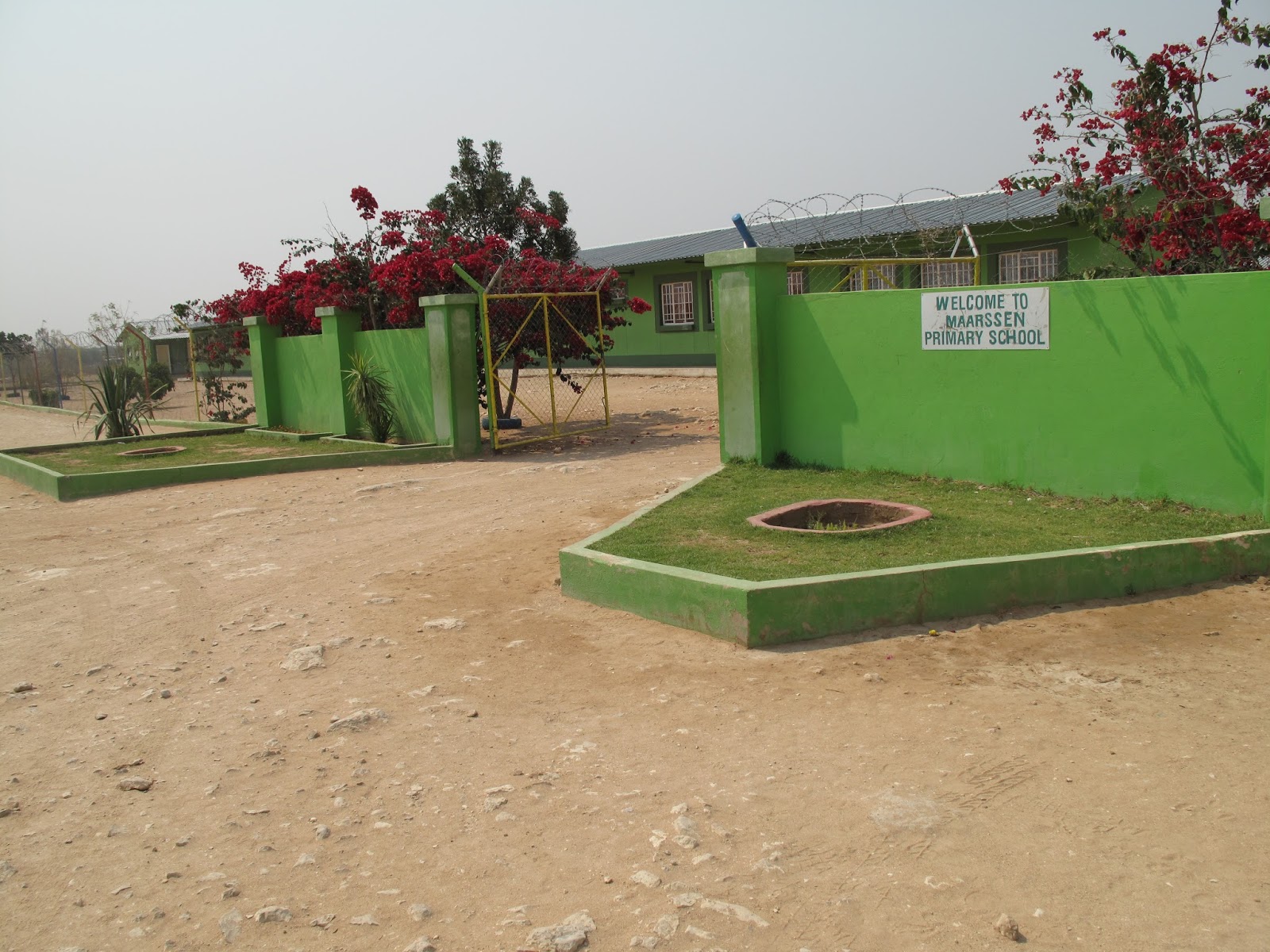
I’ll end with a little bit about my school. As you may
notice from the pictures, my school is really green. As far as low income
schools go here, mine is really amazing. It was built because there were so
many young kids roaming about the Location with nowhere to go. The school is
run incredibly well, something else we have found is really rare for schools that
we will be working at. A lot of the staff really care about the kids. A lot of
money went into making the school environment beautiful in an attempt to make
students more interested in coming. We have a nice garden and pretty green
buildings because of that. The first grade classrooms are covered in learning
material to engage the children where many schools have bare walls. One of the
kindergarten teachers spends her own money and petitions organizations in the
community to donate resources to the school. Still, students are extremely
poor. They can’t afford their own books and pens, so the school provides for
them. Some of them can’t eat at home, so they also can get food after school. A
lot of the kids, we found out, are not Damara (the dominant ethnic population
in town) but San (more commonly known as Bushmen). The San people are one of
two groups that still live semi-nomadic lives, the other being the Ovahimba.
The students at my school are mostly recently settled San people. I haven’t
gotten to talk to them about it and probably won’t, but the teachers say that
one reason for the low performance or general problems at school is because a
lot of the parents don’t value education. Though the staff and teachers are
definitely not without problems, I really appreciate how much some of them do
care.


Sunday, September 13, 2015
CBT and Getting in the Classroom!!
It has been a whole month since we arrived in Namibia. Thus far, I could say I am adjusting pretty
well. I lived with a host family for almost three weeks in Okahandja, which was
really nice. Our family ranged from five to eight people on any given day as
family members moved in and out of our house. Permanent members are my host mom
and dad and my host brother. A week ago we moved, however, to our CBT. The way
that our group 42 is undergoing CBT (Community Based Training) is slightly
different from the way they have done it in the past. Now, we all move to a new
site based on our language groups and undergo language as well as technical
training. Seven of us moved to Outjo last weekend to begin this training.
Ideally, we live with a family that speaks our language, Khoekhoegowab (KKG) or
Damara-Nama. There have been some complications for me on this front as my KKG
speaking family members have either been out of town the whole time (in the
case of my host parents) or are around 10 years old and will not talk to me in
English or KKG. The two people in the house who do speak to me do not speak
KKG. One is my host sister, who speaks English, Otjiherero, and Afrikaans, the other
is her two year old son who only speaks Otijiherero! My parents returned
yesterday and a few other members of the family came over. We had a total of
ten people in our house and it was a bit overwhelming!
Since coming to Outjo, we have also finally started working
in a school. Our group was divided into two groups, four at the primary school,
three at the secondary school. One member of the primary school group ended up
deciding to ET (Early Termination) Sunday night, so only three of us started
school on Monday. Though those teaching at the secondary school have been
having a tough time, the three of us at the primary school are living it up. We
get along well with our colleagues, who seem to like us. The student adore us
and we have a lot of fun interacting with them. Our school is amazingly well
organized, which is something I’m learning is quite special. For most of the
week we have been observing classrooms at our schools. This has resulted in
some amazing learning experiences, some positive, some negative. A few of the
teachers are just amazing teachers. It’s been a real treat to watch their
classes. Some of them are less interested in their students, and some seem to
downright hate them. I sat through a class where the teacher did nothing but
scream at the students, calling them stupid and all sorts of things. I was a
horrible moment in my week. The next day we switched sides and we went to
observe classes at the secondary school. It was very unwelcoming and there were
multiple classrooms where teachers hadn’t shown up all week. I ended up in one
of those classrooms and sort of filled in as the teacher. I had a good time
with the students and got almost everyone to participate in one way or another.
The next day, we were back at primary school, except we
weren’t. I got to school at my usual time only to have the principal pull me
aside and ask if the three of us would attend a conference for novice teachers.
I said it sounded like something we would benefit from since only one member of
our group was an experienced teacher. I told the others about it when they
arrived and we quickly came to realize that she meant for us to LEAD the
workshop, not merely attend. In an hour we threw together a presentation and some
activities on how to asses and incorporate different learning styles and ways
of expression into our lessons as well as implement word walls to create a
classroom environment that encourages reading across subjects. The teacher
member of our group was amazing in organizing everything, but me and the other
non-teacher helped out quite a bit and at the end of the day, everyone in the
workshop was feeling inspired and like they learned something (including us!).
Though ridiculously stressful, I felt so accomplished and inspired by the end.
The teachers that attended were from rural areas and talked about some of the
challenges but also rewards of teaching. Their concern for their students was
powerful. It made me so eager to start teaching!
Now, let me tell you a bit about how my day goes here. I
wake up at 4:40AM most mornings and get ready for work. At 6:00AM I begin my
2km walk to school in the dark. The moon and stars have been beautiful walking
companions. I get to school around 6:40, just in time to greet people and be
ready for the staff meeting at 6:50. School starts at 7:00 and ends at 12:00.
We have an hour break for lunch, though we usually combine that with debrief,
and then language lessons for an hour. Some days we get out by 2:00PM, others
it’s closer to 4:00PM. Then I walk 2km back to town. I usually spend some time
with the other volunteers after work and then head home around 5:00/6:00.
Dinner is at 7:00 or 8:00. Sometimes I cook, sometimes I just help, others I do
nothing. I usually try to get in bed around 9:00, but some nights I just have
too much to do to make that a reality. Then I get up and do it all again! This
week I’m going to push to get home earlier some nights so I can spend more time
with my family.
Oh! I forgot one of the most exciting parts of my week!
There are two Japanese volunteers in my town. One of them even teaches at my
school. We had coffee earlier this week and will go again next week. It was
such a relief to be able to speak Japanese again!! They also gave me the
contact details for a Japanese volunteer in the other town where we will finish
training.
Let me just say, while this week (or even this month) has
been far from easy, I have had so many wonderful experiences. I know I’m not
even an official volunteer yet, but I still can’t help but think that joining
Peace Corps was the best decision for me. I hope that I can keep up this
attitude in the future!
Saturday, September 5, 2015
Red Flag Day
I know this is only my second Namibian post, but it’s going
to touch on some heavier topics, like racism, colonialism, and genocide. Even
though I’ve been here for such a short time, I’ve come to realize very quickly
how Namibia’s history still very much affects the lives of people here and how
it’s going to affect my being here as well. So in an attempt to communicate
this importance to you folks back home, I’m going to try to regularly blog
about events in Namibian history as I become more aware of them.
I typed most of this post weeks ago after the weekend of August
14th. That weekend was a huge celebration for the Ovaherero people
here in Namibia. This year marked the 111th year since the ending of
the German genocide of the Herero and it was commemorated on Red Flag Day.
People dress in the clothing of the Ovaherero, which has been a pretty hot
topic among the other trainees and non-Namibian Peace Corps Staff. The men wear
outfits reflecting German military uniforms from occupation while the women
wear Victorian style dresses. One of our trainers said the reason for the
women’s dress was because during the colonial times, Ovaherero women working in
German households were commonly raped, so the German women would give them
dresses fluffed by a bunch of petticoats as a deterrent to assault. I had read
about the clothing online before coming here, but no one had explained it with
this story, so I feel like it’s something important to get out there. Stories
like this one make a lot of the volunteers and other staff wonder why the Ovaherero
as a culture continue to wear these clothes, but I feel like it’s not something
we have any right to have a say in. However, I think we should be aware of the
history around the clothing.


This year, there was quite a kerfuffle at the festivities.
So much so that we actually were asked by our local trainers to abstain from
Saturday’s festivities. In Namibia there is an ethnic group called the Herero,
which is divided into many different groups or tribes or clans or what you
will. The Himba people who are probably the most well documented group by
foreigners are members of this group, as are the Ovaherero. The Ovaherero have
many different chiefs, but since the late 1800s there has also been a Paramount
Chief who has more power and is chosen by the Paramount Chief before him. The
first Paramount Chief was Hosea Kutako, who the Namibian airport is named
after. For the past three years, the purpose of a Paramount Chief has been
called into question and a lot of people want to go back to only having a group
of chiefs on the same level. There have been many court cases about this
apparently, and this year on Red Flag Day another group of Ovaherero said that
the Paramount Chief and his supporters couldn’t use their land for the
festivities. In the end, they had the festivities, just in another area right
next to the problematic one. I also heard through the less reliable trainee
rumor mill that part of the controversy was over changing the dress, but the
trainer I talked to about the event didn’t make a comment about that. However,
some people did arrive at the festivities Sunday morning in what we all figured
was a more “traditional” style of dress.
For the festivities on Sunday, we went to the cemetery near
the hostel where we’re staying. They were commemorating the death of the last
chief and some other key community members. The reception to our group was
mixed. The racial makeup of our group in general is overwhelmingly white, so
naturally the smaller group that went was also mostly white. I found out from
the trainer who went with us afterwards that a lot of people came up to him and
made comments. They asked him why he brought so many Germans and mentioned
economic compensation for the wrongs committed. Even after explained that we
were Americans and Peace Corps Volunteers, there was still some animosity felt
towards the group by those individuals despite Peace Corps overwhelming
positive reputation in Namibia (which I’ll talk about in a later post).
However, as I said, I only found out about this after the fact when I asked my
trainer to review this post. To our faces, everyone there was super kind and
really welcomed us into the festivities, especially towards the end when a lot
of people began to clear off. Once all the Herero who wanted to venerate the
graves had finished, they allowed us foreigners in to pay our respects as well.
To me, at least, this was a huge honor and I was so grateful for the kindness
showed to us by the members of the Ovaherero community despite our obviously
problematic presence.
I thought to end this post I should say a little about the
Herero genocide that this event is commemorating. According to the above
mentioned trainer, the town of Okahandja is where a lot of key events took
place. The church next to our compound is where a massacre took place. The
Germans locked a bunch of Ovaherero people inside, told them to close their
eyes, and then shot them all. The church now stands as a memorial. I have
walked past it every single day and never known its horrible and tragic
history. According to this article my friend Anna Shilongo linked me to, the
genocide started when the Germans claimed new territory for farmland in Namibia.
The Herero’s living there not in immediate employment by the Germans were told
to leave or else. When they didn’t, they were killed on site or rounded up into
concentration camps. The article says there were 80,000 Herero in Namibia
before the genocide, and after only 15,000. Even now most of the land suitable
for farming is owned by a small minority of Whites while many of the displaced
Herero and other groups have little or even no land. This land issue is still a
huge problem in Namibia today and up for quite a lot of political debate.

To end on a happier note, here’s a picture of some goats I
saw on the way to school one morning:

Thursday, August 20, 2015
First Post from Namibia!
I’ve been in Namibia for just over a week now, so I figured
now was as good a time as any for an inaugural blog post. Hello and welcome.
For those who don’t know me, I’m Mina (Amelia) Sheldon, a soon to be Peace
Corps Volunteer in Namibia. I’m already in country going through Pre-Service
Training (PST), and until my swear-in date in October, I will refer to myself
and the others with me as Trainees.
For training, we have a pretty intense schedule that started
this week, but until now, it was quite relaxed. We were staying in a hostel in a
town called Okahandja and going to classes at a community hall that we
affectionately call the Training Center. Breakfast started at 6 every morning
and we usually headed to classes around 7. Now we are all in host family houses. When I wrote this blog last week, such was not the case! But do to the scarcity of internet here, I haven't been able to post yet and this is already quite long, so I'll post about the host family later.
Our classes are covering a wide range of topics from medical
information, safety lessons (which everyone hates),language, and occasionally culture. We were finally assigned
languages after more than a week, but we won’t receive notification on our permanent site placement
until right before we swear in. Not knowing site placement has been driving
everyone crazy, but now that we know our languages the agony of not knowing is
a little more bearable. Mostly because now we are all struggling through the stages of early language learning.
We have an option of
6 languages we can learn to help transition into our new homes: Afrikaans, KKG,
Oshikwanyama, Oshidonga, Otjiherero, Rukwangali. I personally really wanted to
get KKG, or Khoekhoegowab, a click language that promises to be the hardest
language I’ve ever tried speaking. I practically begged during my interview.
Yesterday they finally unveiled our languages to us through a sort of game. We
were each handed a slip of paper with our name and an animal on it and then had
to find our group without speaking. After finding our group, we were to go to
one of the trainers around the perimeter of the room and again mime until we
found the correct trainer. I was a cat. I walked around and was rejected from
so many different groups and trainers, I was starting to doubt that I was doing
this right. I walked by the KKG tutor I already knew, but the people around him
were all ‘snakes’ so I started preparing myself to have a different language
than my desired one. I still couldn’t find a group. Maybe I didn’t have a group,
which meant I would be alone at Community Based Training (CBT). It all made me
nervous. Then I found to other people with my ‘cat’ motions. We found only open
trainer, who I recognized from the KKG demo. My heart raced. We made our ‘cat’
motions as a group. We waited. Finally, he gave us a thumbs up. That was
probably the happiest I’ve been since I came here. So now I’m learning Damara
dialect Khoekhoegowab.
I’ve also been making a lot of friends through training.
It’s been a pretty stressful week for the introvert that I am, but I realized
that I can check out from time to time and no one really cares. A lot of us are
introverts and everyone is really nice. Our Namibian teachers are also really
kind. They tell jokes with us and teach us to sing three times a week. We love
them all dearly. During down time, I have been hanging out with people, sharing
media interests, playing card games, playing charades, hiking, drawing, and so
much more. It sounds like we stay busy, but over the weekend we had no
scheduled events and the days really dragged on. But now that we are all moving
out of our hostel and into family homes I’m a little sad. I’ll miss everyone a
lot, but I do think I’m ready to move to a new place with a bit more space!
Despite what I have said, however, I’ve already had a few
adventures, so I’ll tell you about them now.
Our first big adventure was to the mall on the outskirts of
town (or, at least I think it is). It took about 20-30 minutes to walk there
both ways. We all went after class on Thursday for cellphones. It was my first
time leaving the immediate area around the hostel and Training Center. I felt
like I got to see a lot more of Namibia there. I could see the beautiful
mountains in the distance. I’m sure I can see them from where we are, but I
hadn’t noticed them as much when there were more buildings and people to be
looking at. The mall itself was really interesting. It was both outdoors like a
strip mall and indoors like what we would think of as a mall without actually
having doors except those on the stores. It was insanely clean for being in the
sandy area that Okahandja is. It took a long time to get the phones, after
which I was thoroughly annoyed and exhausted. I had a good conversation on the
way back with another woman in PST that really helped me overcome at least the
annoyance bit. It made me realize how much I need to grow and put me at a good
starting point for the next two years.
Another adventure was going to the doctor’s office. As could
be expected with me, I’ve already been to the doctor’s! Like when I was in
Korea, my left ear has yet to pop from the plane. I told the Peace Corps
Medical Officers (PCMO) about it and they gave me a few tips of medications I
could take from my med kit and told me to contact them again if those didn’t
work. They did not, so on Friday I told our head trainer and he contacted the
team in Windhoek for me. Within 30 minutes I was at the doctor’s office here in
Okahandja. It was such an interesting place and I’m not sure I could describe
it. It was much more like a US waiting room than the ones in Korea, but there
was definitely something different about it. I met the doctor in his actual
office where he tested my hearing by whispering words at me from behind to see
if I could hear them out of both ears. The words he used were “Jesus, Joseph,
and Joshua.” It started getting a bit predicable after Jesus. In the end, they
couldn’t do anything for me. I had an appointment scheduled for an ENT in
Windheok, but it started getting a bit better over the weekend so I’m going to
see if it’ll just fix itself after a week.
We also went for a hike into the mountains on Saturday
morning. Hiking in the sand was really hard, and moving in the group kicked up
a lot of sand, which made it a little hard on my asthma. I ended up choosing a
spot to stop early on with a friend to sit and draw. We saw some beautiful
birds and made a good halfway point to help direct people back as they came
back down. I now have a pretty painting of the mountain and surrounding bush.
I'm really pressed for time and internet now, but I'll try to get some pictures up next time. I also wrote a post on some interesting history that I will post next time I have internet! There's also a good chance that I need to make a new blog for my service, so please give me ideas for names!!! I like alliterative things!
Subscribe to:
Posts (Atom)